


The first animals we got were hens and pigs, because when I was teaching RS one of my favourite teaching aids was material from Compassion in World Farming. Pigs and hens are the most poorly treated farm animals in the UK, and so we prioritised giving homes to two pigs and eight hens.

HAGAR AND LEAH
Our first ever hens came from the rescue organisation A Wing and a Prayer. When we went to pick up our starter pack of eight hens held in a barn at a smallholding on the road to Bonnington Bridge, seven came quietly, allowing themselves to be caught and put into the large plastic crate we had brought, with holes in the lid for breathing. The eighth fought and scratched like a demented demon. Uninitiated, I assumed she would be difficult. To be fair, even the hen-catcher with presumably some experience and background awareness admonished her, ‘it’s nice to be nice!’ Fervent hopes of his giving up, and her going to someone else, soon faded. Someone with more experience. Surely that would be for the best?
How glad I am that she came to us. Once at home, this terrified scrap of almost featherless, raw-red and pimple bottomed poultry continued to screech, peck at, flap and do her utmost to assert dominance. Last to eat, she was pushed out by the others. She could not get near the bowl, and after only a few days stopped trying, instead waiting until the others had had their fill. It was then we realised that her loudness was mere bravado, a determination never again to be at the very bottom of the pecking order. The ‘Matthew effect’[1] held. Why? a colleague and I have often wondered as we car-shared to school where we taught teenagers with emotional and behavioural difficulties. Why should it be that ‘the first will be last, and the last first. ‘Of those who have not, even what they have will be taken away.’ How do perpetrators know, what subliminal signals are being given that a child is unprotected, vulnerable, the most susceptible.
She was soon joined by a fellow reject from the flock, a gentle soul who accepted her lowly valuation without protest.
The hens were picked up a couple of days before the Beast of the East settled in. Our photos of their arrival and early days were of skinny, feather-light birds, who instead of free-ranging in the garden, were sequestered in their run to keep their feet out of the snow. I very much expect that they did not really enjoy their early taste of ‘freedom’. At least we knew that better hopes were on the horizon, as they ate their layer’s pellets, took supplements and shared a water container from Carrs Billington at Selkirk.
These two were different: even more bald, skinny and scared than the rest. They would have died, pecked to death and unable to eat without waiting for the others to finish and leave. My husband Martin was so moved that he bought a 4 berth wooden hen house to supplement our state of the art, recycled plastic hen arc to house 15 birds, bought patriotically from Solway Recycling from the next county over. Unaware of our loving intentions, they fought like fighting cockerels when picked up to move house. They assumed that they were chosen for ill, no doubt. Housed as a pair, they learnt to eat, drink, love and be hens. Separated from the rest of the flock for their own good, they put on weight, began to eat at a leisured pace, and enjoyed the limited space in their run to the max. They formed a mutually supportive friendship, in which unkindness had no place.
When the snow cleared up, we released the hens from their respective runs, and the main group had the link field next to the woodland, which gave them opportunity to appreciate the branches of spruce which hung over the fence giving a decided woodland feel to their space. As chickens originally lived in woodland in Asia, we hoped that they would feel at home.
However, the two ‘babies’ as we named them, had the run of the main back garden. Both groups were able to dust bathe, hunt for worms and grubs, and run and play from dawn until dusk. The garden hens though enjoyed the sun to a much greater extent, as they could move away from the fence line and the shadow of the spruce. The hens who had formerly bullied them would watch intently, standing along the wood and chickenwire fence dividing the link field from the garden, as ‘the babies’ enjoyed their freedom from being pecked, pushed away from food and water, and chose to run where they pleased. They knew us, and showed no fear when we came to feed and water, despite our huge clumsy wellington’ed feet pounding the earth.
Hens were the very first animal – apart from our sheepdog Noah himself of course – who we welcomed onto Noah’s Arcs. To own a smallholding had been a dream since we were engaged to be married, and talking of the lifestyle we would strive towards. I still have the book, by D S Savage, The Cottager’s Companion, an early compendium of self-sufficiency, long before such became trendy and commonplace. We were awaiting fencing being put in place, by John Skeldon who brough his family to see us and became friends. We needed strong fencing so that the pigs and sheep could be housed safely. My friend Daniel had kept hens for years, as a tribute to his granddad, and was evangelical on the topic. I however felt very sceptical, and doubted that keeping such a small animal as a hen was worth the restriction on lifestyle it would bring.
The dominant birds were named Sarah, Rebecca, Rachel after the Old Testament matriarchs. Identifiable by their behaviour, as well as their plumper bodies and darker colouring. Tamar, as much to remember the river from our beloved Cornwall as to recall King David’s poor daughter, raped by her brother ? and avenged by another brother Absolom, then left to fester in seclusion, unmarried, ashamed and eventually insane. Ruth and Naomi who we hoped would be friends, were identifiable as they shared the same pale bum fluff. The ‘babies’ as Martin continued to refer to them, were Hagar and Leah, for these women had been deemed second-class and lived lives of lesser eligibility.
After six months or so, when some of the larger group hens flew over and showed good hen manners by pecking at the ground insects, and not at the ‘babies’, we showed some compassion, removed the dividing fence and allowed the hens to mingle freely. They still went to sleep in their own arcs, and Hagar and Leah chose to stay close to each other at all times, but they occupied the same space all day.
One day, we had not seen it coming, Leah went into the big hens’ complex to sleep. Hagar remained resolute, sleeping alone. For three days only. Then she went in – the last one to leave the garden at night – to join her friend.
They mingled beautifully, and became fully part of the flock. Initially we could always tell them from the others. They were the plumpest, most confident birds of the flock; always together, and Hagar had her distinctive comb. Yet over time we failed to be able to identify either of them, as all the birds achieved an air of plump contentment. We have had very few spats or unkindnesses amongst these hens, once past the initial months. Martin would watch from the garden window, and if he saw bullying, would rush outside and stamp at the bully. They soon learnt.
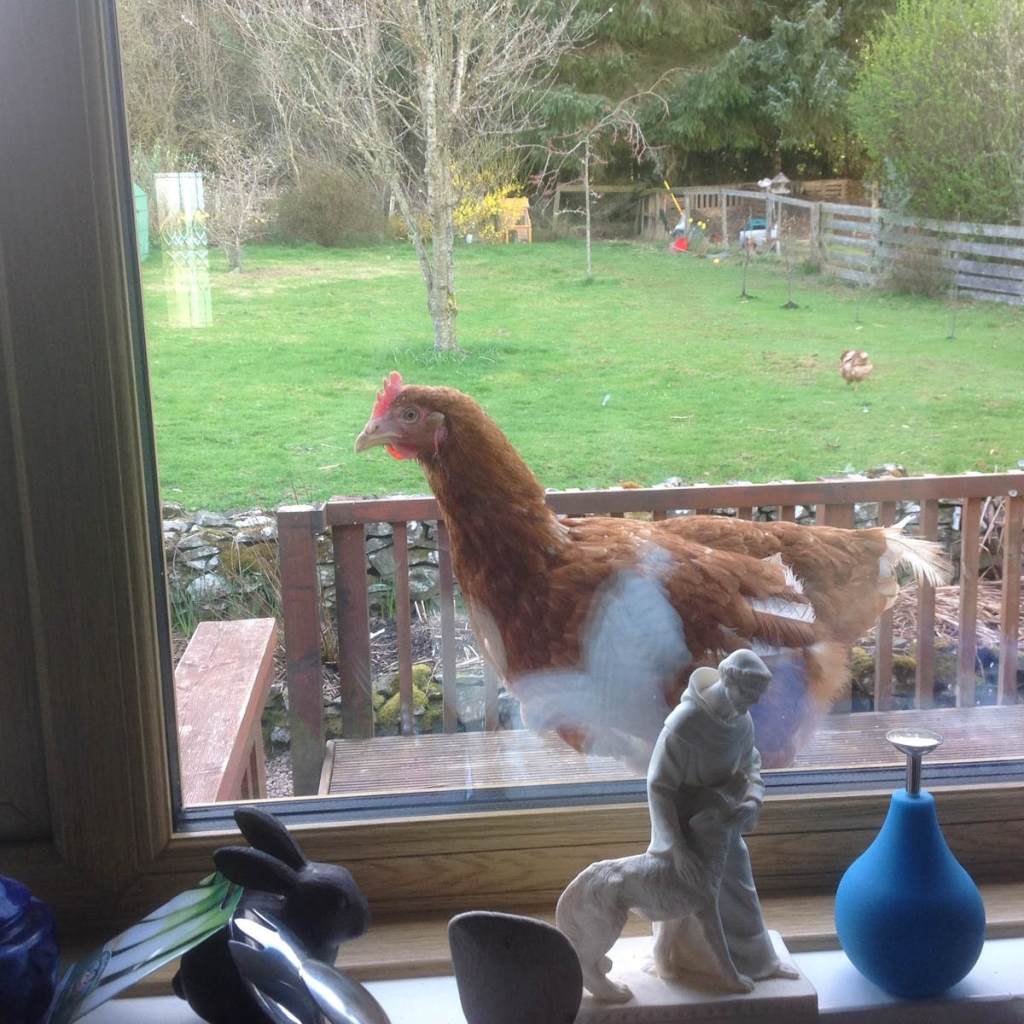
We enjoyed watching them spend a couple of years of happy roaming in the back garden, digging for worms and insects, forming a long queue chasing one hen with a worm or another delicacy, creating dust bathing areas all around the perimeter of the garden, flying up to sit on the decking rim, whilst tapping on the kitchen window with their beaks to let us know we were late with the treats (last night’s dinner, corn on the cob, salad vegetables or mixed corn). I never claimed that they didn’t get to bully us.
Then a hen lay dying in the brown wooden coop. The first coop they had shared together, to get away from the bullying and viciousness. And a friend came to simply lie beside her for the two days and nights, not eating or drinking, that it took her to die. These hens had a very bad start to life, over worked as battery hens for the first eighteen months of their lives, and these two in particular had lived with lesser eligibility.
Five months later, during the hens’ lockdown, the period where Avian flu necessitated all domesticated birds to be confined where they could neither contaminate nor be contaminated by their cousins the wild birds, having fed the hens some half an hour previously, I heard a distinct rumpus from the hens’ lockdown polytunnel. Going to investigate, Hagar or Leah – these birds once so distinct by their different heads – lay on the straw, her head bleeding, legs crooked and stiff. Unmoving, except for twitching. I lifted her. She visibly relaxed, and hope came into her eyes. For Hagar – or Leah – help had obviously come! Mama Hen will do something effective to reverse this nonsense. Unable to fulfil that trust, the faith of this hen who had seen so much cruelty, that I would mend her, all I could do was cradle her against me, preventing the dogs from sniffing at her.
Yet this was early morning, and in winter time there was much to do for the rest of the animals. The sheep needed to be fed with turnips and hay, the pigs with pig nuts and fruit; both needed straw to keep them warm in this devastatingly cold February; the ice on their water needed to be broken (the first time of many this typical winter day).
I had to put her down while I cleaned the big hen arc of last night’s poo, and put in fresh straw to lay her upon. Murmuring endearments I promised to return as soon as I could.
Morning jobs done, I returned to cradle the hen. She was dead. May she rest in peace and rise in glory. God rest her soul.
[1] Rigney, D. (2010), The Matthew Effect: How Advantage begets Further Advantage (Columbia University Press, New York). This book makes a social and educational argument that inequalities in the social and education system will always widen and accumulate. The name of this theory is taken from the gospel of Matthew 13:12, that whoever has will be given more, but whoever has not, even that will be taken from him.
 Noah's Arcs